Hydrostatic Release Unit (HRU): How It Works, When to Replace It and What the Survey Checks
A hydrostatic release unit, or HRU, is the device that frees the liferaft or the EPIRB when a vessel sinks. Water pressure triggers it a few metres below the surface and it cuts the lashing. The liferaft then floats up and inflates on its own. A disposable unit is taken out of service on the […]
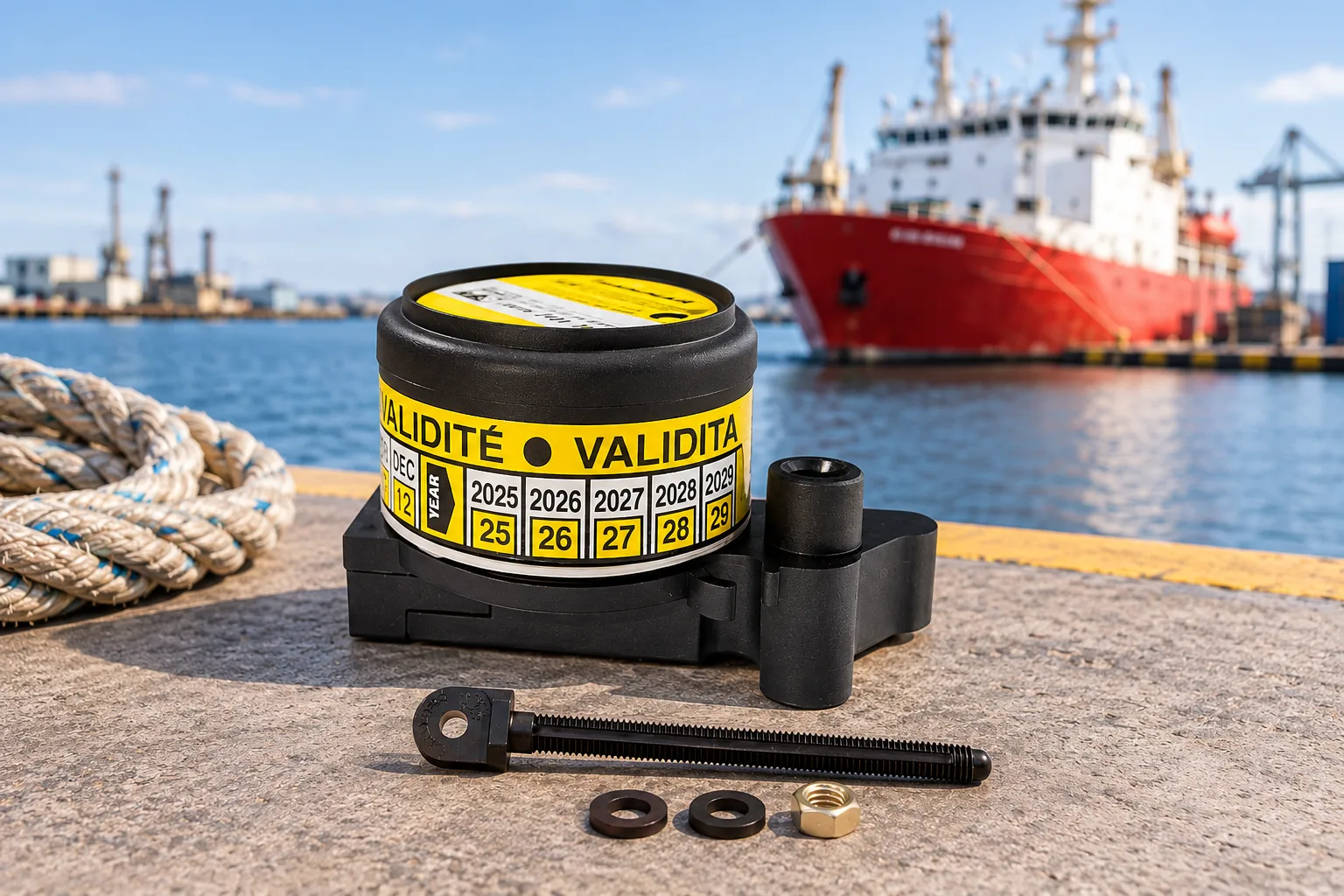
A hydrostatic release unit, or HRU, is the device that frees the liferaft or the EPIRB when a vessel sinks. Water pressure triggers it a few metres below the surface and it cuts the lashing. The liferaft then floats up and inflates on its own. A disposable unit is taken out of service on the date marked on it.
In a fast sinking, the crew may not have time to release the liferaft by hand. That is why the unit sits between the liferaft and the deck and reacts to the water by itself. According to the liferaft hydrostatic release product page, the unit weighs 0.220 kg and is made of rigid PVC.
What the HRU is and why SOLAS requires automatic release
Under SOLAS, the International Convention for the Safety of Life at Sea, a liferaft must release itself when the ship sinks. SOLAS chapter III, regulation 13 requires the liferaft to be stowed with a float-free arrangement. The HRU is the part that makes this arrangement release the liferaft.
The arrangement is detailed in the LSA Code, paragraph 4.1.6, the International Life-Saving Appliance Code. It describes the painter, the weak link and the hydrostatic release unit. The painter is the line that connects the liferaft to the ship. The weak link is a section designed to break under a known load.
Without the unit, a liferaft secured to its cradle would go down with the vessel. With it, release happens even if nobody can reach the deck. This is what is known as a float-free system.
On an inflatable lifejacket, the hydrostatic inflator for inflatable lifejackets inflates the jacket. Despite the similar name, it does not replace the liferaft unit.
Step by step: from sinking to the weak link
A liferaft hydrostatic release activates when the water goes past a certain depth. Under the LSA Code, that point is no deeper than 4 metres. The liferaft hydrostatic release product page states automatic activation between 1.5 and 4 metres.
According to the manufacturer’s datasheet and the UK Maritime and Coastguard Agency’s MGN 343 guidance, the release follows this sequence:
- The ship sinks and water covers the unit, which is fixed to the deck or to the liferaft cradle.
- Water pressure drives a blade inside the unit, which cuts the line of the strap holding the liferaft.
- The liferaft floats up because it is buoyant, pulling the painter out of its container.
- At the end of the painter, the gas cylinder fires and the liferaft starts to inflate.
- The weak link breaks under the pull of the inflated liferaft, which is then free on the surface.
Under the LSA Code, the weak link breaks at a load of 2.2 ± 0.4 kN. The liferaft unit’s product page gives the same value. Strong enough to inflate the liferaft, it breaks right after, so the ship does not drag the liferaft down.
Two other LSA Code requirements explain the unit’s design. It must have drains so that water does not collect inside it. It must also not release when a wave washes over the deck.
Liferaft and EPIRB: same principle, different units
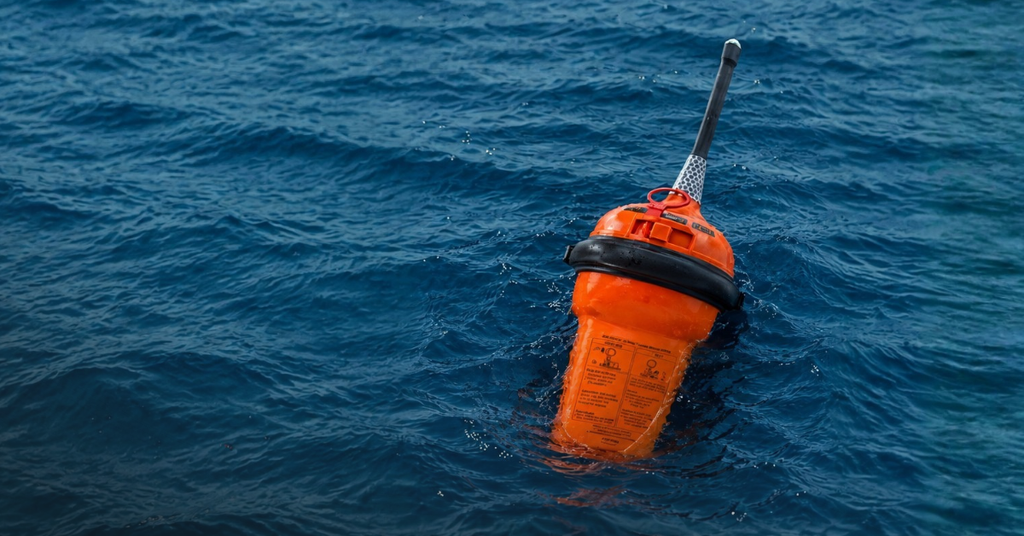
A hydrostatic release for an EPIRB uses the same water pressure but frees different equipment. The EPIRB is the emergency position-indicating radio beacon, the device that tells the satellites where the vessel is. According to the EPIRB hydrostatic release product page, the unit holds the beacon with a plastic bolt that is cut on release.
| Liferaft | EPIRB | |
| What it releases | the liferaft, held to the cradle by a strap | the beacon, stowed in its housing |
| What the blade cuts | the strap line | a plastic bolt |
| Depth stated on the product page | between 1.5 and 4 metres | up to 4 metres |
| After release | the liferaft floats up, inflates and the weak link breaks | the beacon floats up and transmits to the satellites |
| IMPA code on the product page | 330119 | 330126 |
| Product page | liferaft unit | EPIRB unit |
The IMPA code is the number that identifies the item on a marine purchase order. Since each unit serves one type of equipment, one cannot replace the other. According to the FAQ on the Eurosul website, a quote for an EPIRB unit requires the make and model of the beacon.
Expiry: the date is marked on the unit
On a disposable hydrostatic release, the expiry is the date marked on the unit itself, as set by the model’s manufacturer. The LSA Code, paragraph 4.1.6.3, requires disposable units to carry a means of determining when they expire. On the manufacturer’s datasheet for the liferaft unit, this is a label showing the month and year.
The liferaft unit datasheet gives one period for a unit kept in its box and another for a unit installed on board. Rather than memorising a number, read the label and the manual for the model on your ship.
After any activation, a disposable unit must be discarded, even if the date is still far off. At that point it has already cut the line and will not work again.
Under SOLAS chapter III, regulation 20, a reusable unit must be serviced at intervals not exceeding 12 months at a qualified servicing station. In Brazil, NORMAM-201/DPC (formerly NORMAM-01), item 11.11, applies the same rule to vessels on open-sea voyages. It requires a station approved by the DPC, the Brazilian Navy’s Directorate of Ports and Coasts.
Why a disposable HRU cannot be reused
A disposable HRU leaves the factory sealed, with its working parts inside. According to the manufacturer’s datasheet for the liferaft unit, a unit that is dropped or knocked must be discarded. The same datasheet forbids painting the unit or cleaning it with a high-pressure jet.
The LSA Code even prohibits galvanizing or any other metallic coating on the unit’s parts, to prevent release failure. Reusing an expired unit takes away the only control the owner has: the date.
Installation: the mistake that keeps the liferaft tied to the ship
A painter tied in the wrong place keeps the liferaft attached to the ship even after the unit has released. The mistake happens when the painter is made fast to the strap, the cradle or a fixed point on deck. Under the MGN 343 guidance, after release the painter should be attached to the ship only through the weak link.
If the painter is tied to another point, the liferaft may still inflate. But it stays tied to a ship that is heading for the bottom. That is why the UK guidance says no line should pass through the cradle in a way that could hold the liferaft.
During routine inspections, check:
- The painter attached to the weak link, as shown in the model’s manual.
- The strap running through the unit, so that the cut actually frees the liferaft.
- The lines clear, not passing through or snagging on the cradle.
- One liferaft per unit, unless the unit is approved to hold more than one.
- The date label legible and within date.
According to MGN 343, tests at 4 metres showed that the buoyancy of several liferafts attached to the same unit can prevent it from opening. Buoyancy is the force of the water pushing the liferaft upwards.
To secure the liferaft on deck, the galvanized cradle with lashing wire uses an adjustable strap. Full assembly follows the liferaft manufacturer’s manual and the servicing station’s instructions.
What the survey checks on the liferaft and the EPIRB
During a survey, the hydrostatic release is checked for its date, its markings and its installation. For the EPIRB, IMO circular MSC.1/Circ.1040/Rev.2 provides guidance on the beacon’s annual test. Among the items, it calls for checking the hydrostatic release and its expiry date, as well as the battery expiry. The IMO is the International Maritime Organization, which writes SOLAS.
On the liferaft, the LSA Code requires permanent marking of the unit’s type and serial number. The liferaft is also serviced: under NORMAM-201, item 11.11, it goes to a DPC-approved station at intervals not exceeding 12 months. That is a good time to replace any unit that will expire before the next service.
For the beacon, the float-free EPIRB housing comes with the HRU. The replacement part depends on the beacon and housing model.
How to spot a reconditioned unit
A reconditioned unit is an expired release that someone has refurbished and resold as new. Classification society Lloyd’s Register warned about the problem in Class News 04/15. According to the notice, a refurbished unit may fail to release, and the liferaft or EPIRB may not float free.
In the reported cases, the original label had been removed and replaced with a poor-quality one. That label wore out shortly after installation. Found one like that on board? Take the unit out of service immediately.
Be wary of faded or peeling labels and, as the notice recommends, buy from an authorized distributor or a liferaft servicing agent.
Frequently asked questions
What is an HRU?
HRU stands for hydrostatic release unit. It is the device that frees the liferaft or the EPIRB when a vessel sinks. Water pressure triggers the unit, which cuts the lashing. The liferaft then floats up and inflates, and the EPIRB starts transmitting.
How does a hydrostatic release work?
A hydrostatic release responds to water pressure. When the vessel sinks, an internal blade cuts the line holding the liferaft. The liferaft floats up, pulls the painter and inflates. Finally, the weak link breaks and sets the liferaft free. On an EPIRB, the blade cuts a plastic bolt.
How long is a hydrostatic release valid?
For a disposable hydrostatic release, the expiry is the date marked on the unit, as set by the model’s manufacturer. Each model counts the period in its own way, from installation or from manufacture. Read the label and the manual. After activation, a drop or a knock, a disposable unit must be taken out of service.
At what depth does a hydrostatic release activate?
The LSA Code, the International Life-Saving Appliance Code, requires the liferaft unit to release the liferaft at a depth of no more than 4 metres. The product page for the liferaft unit sold by Eurosul states activation between 1.5 and 4 metres. The EPIRB unit’s page states up to 4 metres.
Can a hydrostatic release be reused?
A disposable hydrostatic release cannot be reused. After activation or its expiry date, it is taken out of service. A reusable unit is a different type of device. Under SOLAS and NORMAM-201, it must be serviced at intervals not exceeding 12 months at an approved servicing station.
Read also:
- EPIRB and SART: operational differences and their role in the GMDSS
- Emergency nutrition: what’s inside SOLAS survival rations?
- GMDSS and emergency communication at sea: what ensures reliability in critical situations
Order the right release unit for your liferaft or EPIRB
Founded in 1999 in Pinhais, Paraná, Brazil, Eurosul sells hydrostatic release units for liferafts and EPIRBs, with stock on hand and sales by quote.
Send us the make and model of the liferaft or EPIRB and the date marked on your current unit. With that, our team will confirm the compatible unit and availability. Contact the Eurosul team or reach us on WhatsApp +55 41 3668-1319.
Sources:
- IMO. Resolution MSC.47(66), SOLAS chapter III, regulations 13 and 20
- IMO. Resolution MSC.48(66), LSA Code, paragraph 4.1.6
- IMO. MSC.1/Circ.1040/Rev.2, annual testing of EPIRBs
- Brazilian Navy, DPC. NORMAM-201/DPC
- Maritime and Coastguard Agency. MGN 343, stowage and float free arrangements for inflatable liferafts
- Lloyd’s Register. Class News 04/15
Share